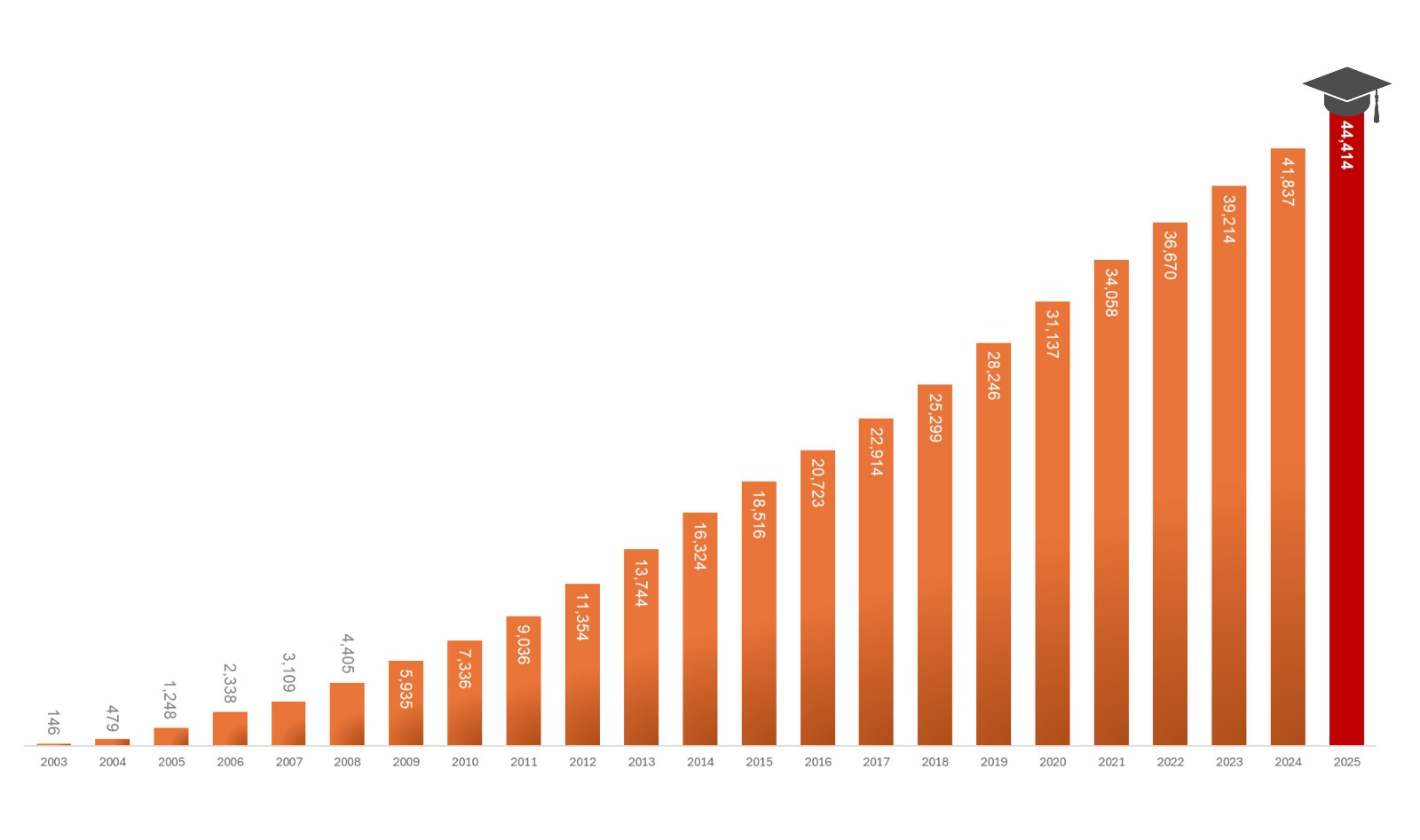
From the first cohort of graduates in 2003 to those in 2025, 44,414 HKCC graduates have articulated into bachelor's degree studies. This represents a 23-year average articulation rate of 85%, which ranks among the highest in Hong Kong.
2025 HKCC Graduates' Articulation Rate Reaches 90.4%, with 64.2% Admitted to Government-funded Programmes
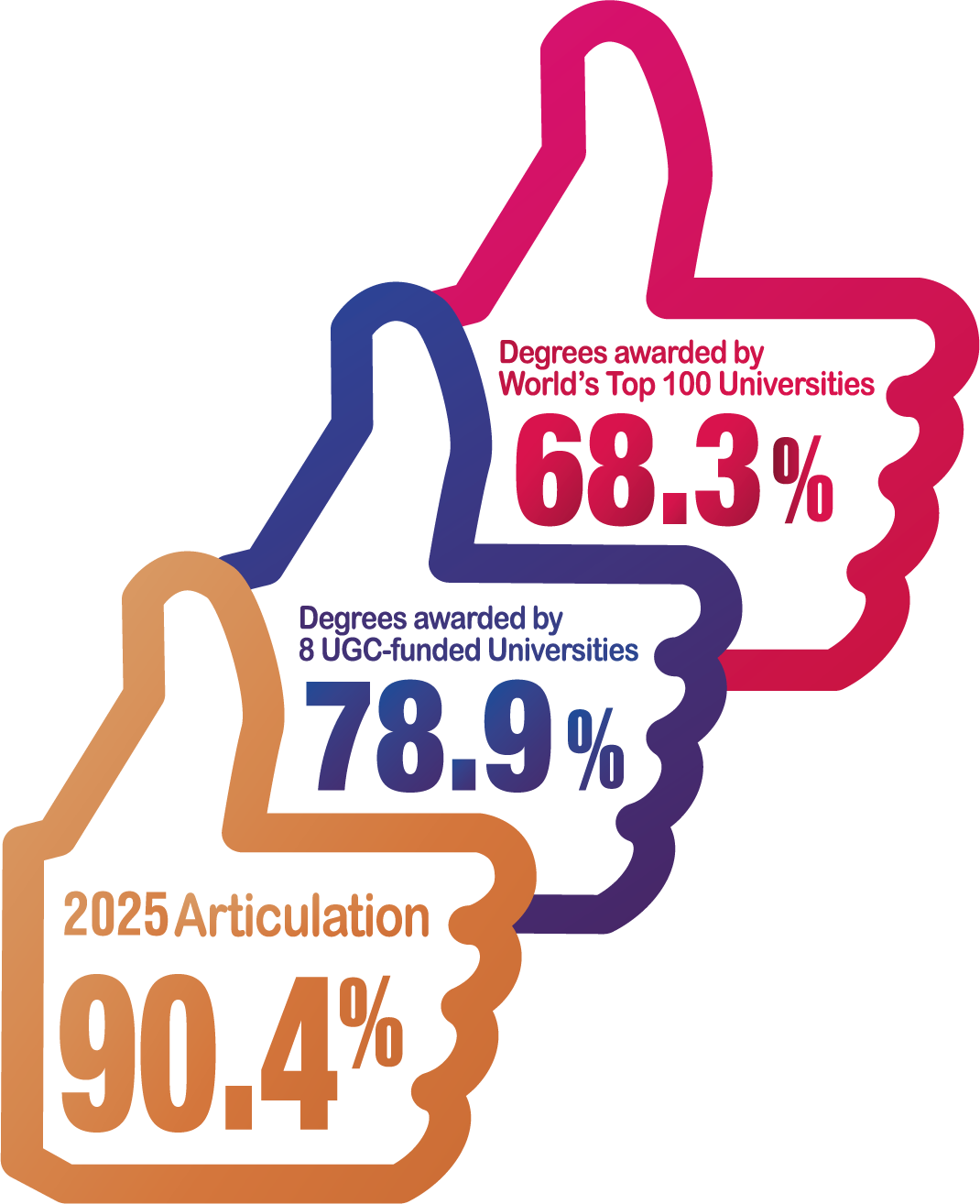
According to the HKCC Graduate Survey 2025, a total of 2,577 graduates articulated to bachelor's degree programmes, representing a high articulation rate of 90.4%. Among those:
Regarding articulation opportunities provided by PolyU, among the 2,577 graduates who articulated into bachelor's degree programmes, 34.7% were admitted to PolyU, while 14.2% enrolled on self-financed undergraduate top-up degree programmes offered by PolyU SPEED. (Click here to learn more about PolyU SPEED's Conditional Offer Scheme for HKCC graduates.)
#Including self-financed programmes
^The world's top 100 universities refer to five local universities ranked in the top 100 of the QS World University Rankings 2026: The Hong Kong Polytechnic University, The University of Hong Kong, The Chinese University of Hong Kong, The Hong Kong University of Science and Technology, and City University of Hong Kong. For details, please visit www.topuniversities.com/world-university-rankings?region=Asia&countries=hk.
From the first cohort of graduates in 2003 to those in 2025, 44,414 HKCC graduates have articulated into bachelor's degree studies. This represents a 23-year average articulation rate of 85%, which ranks among the highest in Hong Kong.
The pie chart below gives you an overall picture of the distribution of articulated graduates by number and university/ institution in 2025.

| Number of graduates | 3,558 |
| Number of respondents | 2,850 |
| Response rate | 80.1% |
| Number of articulated graduates | 2,577 |
| Overall Articulation rate | 90.4% |
|
64.2% |
|
78.9% |
Understanding Articulation Rates for Associate Degree and Higher Diploma Programmes from a Well-rounded Perspective
When enrolling in an associate degree or a higher diploma programme, articulation rates are your primary concern as such figures directly tell you the ratio of graduates articulated to a bachelor's degree programme and indirectly reflect the teaching quality of an institution. However, local institutions do not have a set of unified criteria for calculating articulation rates, resulting in numerous ways of data interpretation which may confuse you.
The following sections explain how to interpret the articulation data of graduates of self-financing tertiary education institutions from different perspectives in an objective manner so that you can understand how high your chances of further study are in the future and make an informed choice when applying for admission.


Q1: What should I pay attention to when comparing the articulation rates for sub-degree graduates from different self-financing tertiary education institutions?
ExpandAlthough the overall articulation rate can reflect the ratio of graduates from a particular institution successfully articulating a bachelor's degree programme, you must also pay attention to the actual number of articulated graduates. For example, the overall articulation rate for sub-degree graduates of College A is as high as 100%, but the actual number of graduates is less than 10; on the other hand, the overall articulation rate for sub-degree graduates of College B is "only" 80%, but there are more than 2,000 graduates in that cohort. The overall articulation performance of College B is far better than that of College A.
For example, the articulation rate for HKCC in 2025 reached 90.4%, with a total of 2,577 graduates pursuing bachelor's degree programmes. Both the overall graduation rate and the actual number of graduates reflect the outstanding academic performance of the College's graduates.
Each year, the government allocates funds to the eight UGC-funded universities for sub-degree graduates to articulate to UGC-funded Senior Year Places through the Non-JUPAS route. The number of such places is limited, and the competition is fierce. Therefore, the higher the rate for graduates of a particular institution articulating to UGC-funded Senior Year Places, the stronger the competitiveness of the graduates of that institution.
For example, in 2025, a total of 1,370 (53.2%) HKCC graduates were articulated to UGC-funded Senior Year Places. This means that approximately one out of every two graduates was able to enrol in a UGC-funded senior year place, which is a very high rate.
To further study in Hong Kong, your first choice is to go to the eight UGC-funded universities: The Hong Kong Polytechnic University, The University of Hong Kong, The Chinese University of Hong Kong, The Hong Kong University of Science and Technology, City University of Hong Kong, Hong Kong Baptist University, Lingnan University and The Education University of Hong Kong. The higher the articulation rate for the above eight universities, the better.
For example, in 2025, 2,034 HKCC graduates pursued programmes at the eight UGC-funded universities (including both self-financed and funded programmes), representing a rate as high as 78.9%.
Generally speaking, the average articulation rate over the years is more objective because it combines the articulation data of multiple years, but the year-on-year articulation rate is also useful as it can reflect the stability of the articulation rates for a particular institution over the years and whether there is a long-term upward or downward trend. In addition, you should also pay attention to the year-on-year articulation rate for a particular institution in the past two or three years. If it is steadily increasing, it may mean that the institution has invested a lot of resources to enhance the quality of lecturers and programmes. On the contrary, if there is a sudden and sharp drop or even without relevant data, you should verify carefully whether there is something wrong with the institution.
The articulation rates for HKCC graduates in 2020 (90.5%), 2021 (90.7%), 2022 (90.1%), 2023 (90.2%), 2024 (90.35%), and 2025 (90.4%) have consistently exceeded 90% for six consecutive years, reflecting that HKCC has been successful in increasing graduates' chances of further studies in recent years.
You can first check the graduates' articulation overview of different institutions on CONCOURSE, but the relevant information may not be up-to-date. If in doubt, you may visit the websites of the institutions as follow:
|
Institution |
|
|
HKMU Li Ka Shing School of Professional and Continuing Education |
|